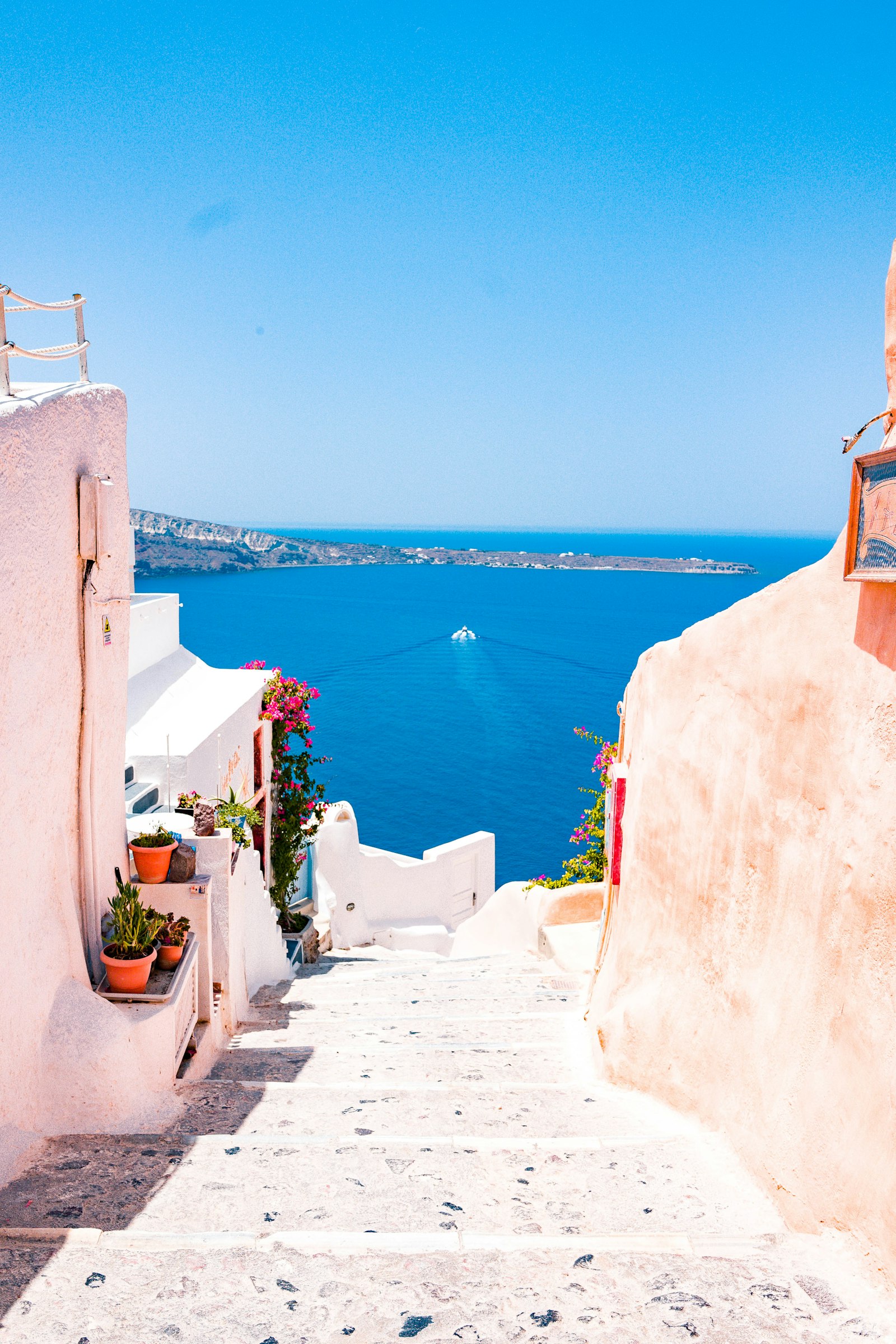
At half past five the village still belongs to cats. They occupy the warm corners of doorsteps, the ledges under bougainvillea, the last patches of night heat held in stone. Lindos has not yet become a postcard of itself. The chalk walls are blue at the edges. The sea below is a sheet of dark glass waiting for the first crease of wind.
I climbed from the lower lanes toward the acropolis path with a notebook that already smelled faintly of thyme. That is the first lesson of Lindos: the village is not a single viewpoint. It is a sequence of thresholds — arched passages, sudden courtyards, staircases that turn you ninety degrees into a different quality of light. You do not “see” Lindos so much as you are edited by it, frame by frame.
Chalk, shadow, and the grammar of lanes
Whitewash here is not merely paint; it is a climate strategy and a social signal. It throws the sun back into the sky and keeps interiors cool enough for midday sleep. It also creates a continuous surface against which shutters, doors, and the occasional flash of cobalt become punctuation. Photographers love this geometry, but residents live inside its practical poetry. A bucket of whitewash, refreshed after winter rains, is as ordinary as bread.
In the narrowest passages you hear footsteps before you see faces. Sound travels oddly — sometimes muffled by hanging laundry, sometimes amplified by bare stone. Early vendors arrange fruit with the calm of people who know the day will accelerate whether they hurry or not. A woman swept her step in long, practiced arcs. A radio murmured from an upper window: a song I did not recognize, carried on a frequency of domestic life that tourism never quite purchases.
Lindos teaches you to walk as if the village were reading you — testing whether you can match its pace before the heat arrives.
The bay as a second sky
From certain terraces the bay appears twice: once as water, once as reflected light thrown onto walls. Fishermen’s boats sit like commas on the surface. The famous crescent of sand will later fill with color and conversation, but at dawn it is almost austere — a pale rim between rock and sea. I watched a swimmer cut a slow line offshore, the only moving vertical in a horizontal world.
Above everything, the acropolis holds the ridge like a thought you cannot finish. Knights rebuilt on older sanctuaries; the stone remembers more than any single plaque can list. Even if you do not climb that morning, the citadel rearranges the village beneath it. Rooflines defer. Alleys aim. The eye keeps returning upward, the way a sentence returns to its subject.
How a hillside keeps its voice
By eight o’clock the first small groups appear with maps and good intentions. Lindos does not resent them; it has hosted strangers for millennia. What changes is tempo. Donkeys begin their patient work on the steeper approaches. Shop shutters lift. The scent of coffee replaces the scent of cooled stone. If you want the village’s quieter grammar, you have to earn it with an early alarm and a willingness to linger where there is “nothing to do” except notice.
I sat on a low wall and counted the layers of sound: a scooter far below, a spoon against a cup, the dry click of cicadas warming up. A boy carried bread in a paper bag almost as tall as his torso. Two elderly men argued gently about football as if the score could still be negotiated. These are not scenes arranged for visitors. They are the village continuing.
Later, when the sun stands hard overhead and the white becomes almost too bright to look at, Lindos will seem simpler than it is — a beautiful cliff town, a swimming day, a photograph of blue doors. The dawn walk complicates that story in the best way. It shows you that the famous view is only the last page of a much longer paragraph, written in lime, salt, and the stubborn continuity of people who whitewash their walls because winter always comes, and summer always returns, and the bay keeps shining either way.
When I left the lanes for the coastal road, I looked back once. The village had already begun to glitter. Cats had moved into deeper shade. The acropolis stood in full gold. Lindos, for a few hours, had let me listen. That felt like the real souvenir — not something to carry home, but a way of walking I hoped to keep.